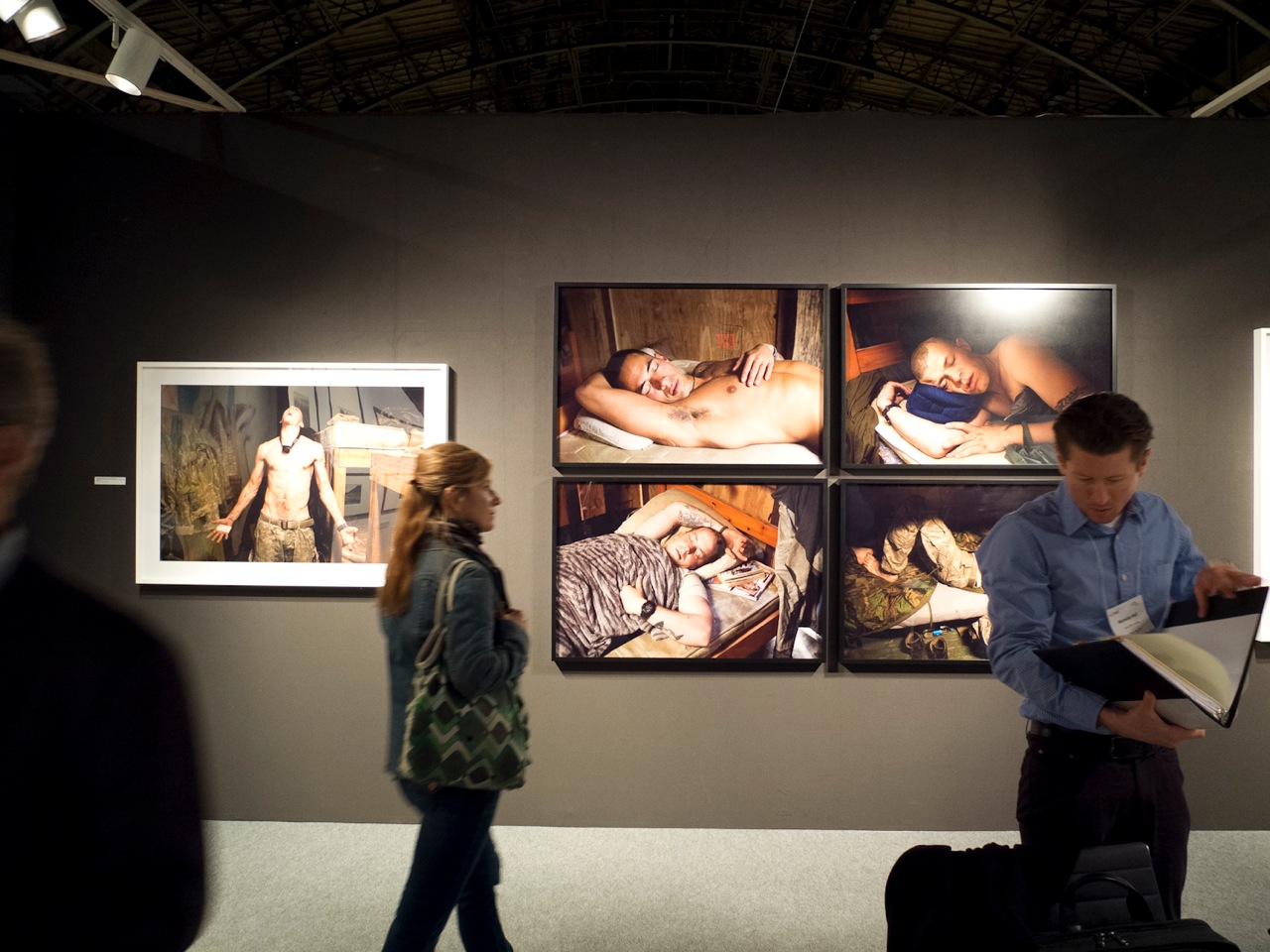
I went through
AIPAD this year with
Walter Mason of the
Haggerty Museum, and he gave me a real lesson in prints and prices. It was fascinating since that is not my forte. And since we felt the same way about a lot of the work, I had a great time at
AIPAD this year.
Let me just say that I was much more interested in the vintage prints than most of the contemporary work I saw. The luscious silver gelatin and platinum prints were so glossy and delicious I would have loved to buy them all. There were small gems everywhere you looked. I loved the cinematic quality of
Yutaka Takanashi work from the mid-60's, and the multitude of anonymous historic images.
There were a number of
Civil Rights-era photos capturing historic moments seen by
Charles Moore,
Steve Schaprio,
Bill Eppridge,
Grey Villet and others. I was really moved by them and felt reconnected with American history in a way that seems almost lost these days.

Charles Moore: Demonstrators Blasted Against a Doorway, Seventeenth Street, May 3, 1963.

As James Chaney's family awaited the drive to his burial, 12-year-old Ben gazed outward by Bill Eppridge (Monroe Gallery of Photography)

Grey Villet: The Little Rock Nine (Monroe Gallery of Photography)
There was a wonderful print of
Eddie Adams' famed Pulitzer Prize-winning photo of the point-blank execution of a Vietcong suspect, complete with red grease pencil crop line.

There was a decent amount of contemporary photography this year, and so much of it were large prints, frequently for no apparent reason that I can see except it has greater impact. I saw
Alec Soth's new work, Broken Manual and wasn't especially impressed. I feel the same way about
Alex Prager (below Film Still #1-Yancey Richardson Gallery). I can see the reasoning behind the work, but it just seems that it's an idea made for maximum sales. That's the same way I feel about
Cindy Sherman's work. I can see why people would buy it, I just don't see the deeper meaning.

I saw some work that leaves me scratching my head and worried about the future of the medium.
Lynn Bianchi's Dinner Conversation (below top), and
Meghan Boody (bottom) are photographers whose work I really don't understand. It has no resonance with me, and seeing it at
AIPAD makes me wonder who decides what is valuable. I know that art is subjective, but in a place filled with truly important and wonderful work, how did these pieces find galleries?


I did like the following work:
Mark Seliger's nude from the
Steven Kasher Gallery. I was sorry I missed this show, as I know Mark to be a photographer with real depth that you might not be aware of if you judge him simply from his
Rolling Stone or
Vanity Fair work.

How could you not love
Robert Mapplethorpe's portrait of
Patti Smith?

And
Richard Renaldi's
Smashed Water Tower (Robert Morat Galerie) is a delight, looking like a deflated balloon in the landscape.
 Martine Fougeron
 was there with her wonderful work of teenagers in all their glory, a class contrast with
Chris Killip's early 80's portraits of British kids. And then there were these wonderful photograph--
Frida Kahlo in New York, and an amazing
Norman Parkinson. So fresh and exciting; why I don't see more exciting work like this?


I see so much derivative work around. I guess that's to be expected in general, but to see things at
AIPAD that are photographs of subjects others have done more successfully is a shame.
Christian Patterson was an assistant to
William Eggleston, and you can just tell by looking at the work. Couldn't he have chosen different subject matter to base his career on? Or is he represented by a gallery
because he was
Eggleston's assistant?
Michael Wolf's
Google Street View series was represented by a giant print, and it still makes me furious. Talk about doing nothing to create something. Taking a photo of a screen does not make a body of work. And the weird thing was I really liked another body of his work, showing faces seen through the windows of Japanese commuter trains. I believe the series is called
Tokyo Compression. Those were wonderful, giving me a glimpse into the people caught staring blankly out of train windows. I loved the way faces were smushed into the glass, with condensation covering the windows.

I also loved the vintage prints of
Herbert Ponting, taken during
Robert Falcon Scott's
Terra Nova Expedition to the
Ross Sea and
South Pole . The portraits were so beautiful, the men so attractive, it was almost like a Ralph Lauren ad. You would think they were fashion models if not for the frost-bitten lips and skin. (Courtesy Steven Kasher Gallery)


I have seen so many animal portraits--dogs seem to be of special mention.
Charlotte Dumas' (top) portraits didn't impress me as much as
Ponting's portrait of the heroic Sled Dog. (bottom)


Steven Kasher Gallery
But perhaps the most confounding work I saw was
Ayano Sudo's "They are not me, but me" series of portraits. Done with candy colors, and glitter! (yes, you heard me right), they sprang from the world of Japanese child-like culture, full of surface youth and beauty, with nothing deep to ground them in reality. I can see why people would buy them and think they were very cool for owning something like this, but to be honest, these images depress me. They are like candy cotton (and even reflect those colors), and it's as if you could eat them without having realized it. All style with no substance.


I thought art was meant to challenge or illuminate the world for us. At best they express emotions that pull us into their world and upset our way of looking at things. Or at least that is what I'd like to think. Too much of what I saw at
AIPAD was mediocre. The work didn't stay with me, didn't make me think about it days after the show. If I wasn't writing this it would already be gone from my mind. I understand that galleries need to make money too, but is that a substitute for showing unexceptional work, often at sizes that you cannot ignore? Size alone doesn't add to my understanding of the work.
That really struck me. If you're a photographer without a gallery behind you, what do you do? Do you print giant photographs for attention, do you find a sellable idea and exploit it? What if you just want to make great photographs? Or follow an idea as far as it will go? Will you ever get your work before a larger audience?
I wonder what photographers felt after attending
AIPAD. Was it just a chance to see some wonderful work? Did you leave feeing energized or demoralized? I'd really like to know.
Labels: AIPAD, bill eppridge, charles moore, grey villet, haggerty museum, herbert ponting, mark seliger, photoraphy, richard renaldi, stelazine, stella kramer, steve kasher gallery, walter mason