IMPORTANT NOTE

Stellazine has moved to stellakramer.com/category/stellazine


Thursday, August 2, 2012

Committing to a photography project takes passion, dedication, and it always takes money.  Self-funded projects are proof of a photographer's dedication to the story they want to tell the world.  I want to focus on two extraordinary projects that are pushing forward right now, projects you can help to see the light of day.


Marissa Roth has been photographing woman in war zones for 28 years.  She has brought her work together into "One Person Crying: Women and War," and a Kickstarter campaign to help with the expense of producing a traveling exhibition of the work. As Roth says,
"The consequences of war for women in countries, cultures and communities that are directly affected by it, have often been overlooked. My main hope for this project is to show that war doesn’t discriminate how it metes out pain or suffering, that women are basically the same everywhere in how they endure war and live with its aftermath into their post-war lives."
From Serbia to Vietnam to Afghanistan and Northern Ireland, Roth has photographed and interviewed women to hear their stories and record them for others to hear.  The project is now finishing, and The Museum of Tolerance in Los Angeles will be debuting a major exhibition of this work on August 16th, with 88 black and white photographs.  But Roth is looking to take this project further, and bring it to audiences everywhere.  That's how important it is.

You can help make this happen here:


Jason Florio and Helen Jones-Florio are passionate explorers who have made The Gambia, Africa their particular focus.  In 2009 they walked the length of the country.  WALKED the length of the country, a total of 930km!  This time out they are going on a river journey, a 1000km journey through three countries: Guinea, Senegal and The Gambia, following the Gambia River.

The Florios want to create a modern-day account of the people, societies, and life along the length of one of Africa’s last, free-flowing, major rivers. There have been rumors that the river is to be dammed, and the Florios want to try and document the people and environment before it happens.

They plan on traveling by canoe and foot through the homelands of over seven different tribes.  The journey will,
"begin at the source of the river, where it trickles out of the Fouta Djallon highlands, of Guinea, on into hippo-abundant Niokolo Koba National Park, Senegal, and finally into The Republic of the Gambia - following the same course as the early gold and slave traders had done century’s ago – to the 10km wide mouth of the river, where it opens into the Atlantic Ocean." 

To fund their expedition the Florios are reaching out for sponsors and donations of money and equipment through their website, and where, for just $25 you have a chance to win a print from Jason Florio
"An Exchange – print draw: Just $25/£16 puts your name in the hat and you could pull out one of Jason Florio’s fine art photography prints – Deadline 31st August 2012"
You can read more from Jason here. And follow their journey here and on Facebook

And please consider donating  here

These photographers are working hard to tell stories not being told anywhere else.  And it's important to support these independent endeavors.  I have and I hope you will join me.  The returns are going to be fantastic!

Labels: , , , , , , , , ,

del.icio.us Digg it Facebook MySpace Slashdot Technorati Stumbleupon Twitter

Thursday, July 26, 2012

Cute Kittens and Bunnies


Did I get your attention?  Good.

We all face the same problem: How can we get our work seen and acknowledged?  I’ve been thinking a lot about what we do to get attention; what we do to make people see us.  We’re told all the time that we “need to create buzz,” and there are examples of those successes all around us.

So what are you doing to create that buzz for your work?  Do you find it difficult to publicize yourself and your work, not wanting people to think you’re boasting?  After all, we’re told it’s not polite to stand up in the world and say, “Hey, look at this great thing I’m doing (I’ve done).”  Maybe you think you don’t deserve the special attention.  Well it’s time to silence those voices in your head.  You can be the most fantastic photographer in the universe, but if no one knows you’re there, what difference does it make?

What’s wrong with being proud of your work and wanting to share it, to let people know you feel strongly about it?

There are so many ways for you to get noticed, to stand out from the crowd these days.  It’s wrong to think that in this world with billions of people just being talented is enough.

But are you trying to be all things to all people--a jack-of-all-trades photographer? Do you think that if you can do many things it makes you more attractive to a potential client? Yes, some people are able to build a career doing just that and if that’s what you really want to do, great. But think for a moment: If a potential client has someone who shoots everything for them, why would they hire you?

It takes looking deep inside yourself to really get at what you are good at and more importantly, what you really want to do.  You have to be brutally honest with yourself to find out whether you have what it takes to be a successful photographer.

Once you’ve made the commitment to yourself, what’s next?  I’m going to cut to the chase here.  Getting noticed is not just about throwing your work online and then Tweeting or putting it on FB.  It’s about engaging others to take a look.  It’s about presenting your work without fear.  There are ways to put your work in front of people in the industry, whether it’s at a portfolio review or through establishing a relationship with someone you want to work for.  Even more, it’s about getting out of your shell, getting out of your own way, and making opportunities for yourself, instead of waiting to be found and brought out of the wilderness.

You cannot make everyone want to work with you no matter how good your work is.  But you don’t need that.  You are not competing with everyone who has a camera.  You are competing with yourself, and those people who really move themselves forward: the go-getters, the innovators, and the people who have the creative drive to be successful.  And that’s a much smaller group than you think.

So, do you have the courage to be unique?  Are you willing to be true to yourself, and willing to stand behind that decision?  Are you ready to take possession of who you are and what you do?  Or are you waiting for someone to take you by the hand and give you what you think you want?

Challenge yourself. Give yourself permission. Stand up and let the world know you’re here.

Labels: , , , , , ,

del.icio.us Digg it Facebook MySpace Slashdot Technorati Stumbleupon Twitter

Wednesday, July 11, 2012

Come On Girls, Let's Take PIX!


She's young!  She's blonde!  She's cute!  She's the embodiment of women photographers!

There’s been blowback against Nielsen and PDN on FB and Twitter for their proposed new magazine, PIX, aimed at women photographers.  And more here and here .

With stories like:

"Smudge-proof makeup tips for long days behind the camera"

"Seasonal Flats: these flats will keep your feet covered, comfortable and cute while you're on photo shoots,"
and stories on wedding photography and photographing newborns, you might think you had traveled back in time.  It’s easy to think that, but what really gets my blood boiling, is that once again, women are being marginalized.

Yes, we may be half of the population (and yes, we hold up half the sky), but why do we need to be singled out?  And why, once again are we being told that shopping is an integral part of a profession?  We've been bombarded by TV shows about weddings, wedding dresses, wedding as competition, by “Bad Girls Clubs,” and fame through Internet sex tapes; by the recent rape “jokes” of a so-called comedian, and by major magazine stories like TIME’s “Are You Mom Enough?” (to single out just a few).  It's as if there never was a feminist movement.

And for every strong woman in the public eye there is a story commenting on her hair, her looks, why she’s a bitch, or how nice her clothes are.  All of MSM is responsible, but they are not alone.  The “girlization” (I didn’t make that up) of females in our society has been going on for a while now.  And as much as I love the craft world, and the attention to décor and design, they focus so much on “cuteness.”  Since their primary audience is women, they also take part in making all women seem only focused on shopping and the home.  They make women seem non-threatening and they put women in their place.

"If you love to snap photos, chances are you're pretty creative and artsy about the rest of your world too," writes Pix's Editor-in-Chief. "It's important to you that your business is modern and cool, you've always got an eye out for hip clothing and accessories, and looking professional and shooting well are top priorities." 

In the past year photographers have been kidnapped, assaulted, and killed.  Women photographers have had to defend themselves against claims that they shouldn't shoot what they do.  Will smudge-proof makeup” or “luminous lenses” help in Syria?  Ask Lynsey Addario, or Stephanie Sinclair, or Kate Brooks, or any number of women what they think. Do you think Margaret Bourke-White was worried about her mascara when she photographed Buchenwald? When did selling clothing and accessories become a cash cow for a photography-focused media company?

When we look around, all we see are efforts to defame and marginalize women.  It’s not just the Taliban who keep women down.  Republicans around the country are proposing and passing laws to keep women pregnant; to keep them without access to healthcare or child care or jobs training, or anything that might help propel them forward. Rape is still used as a tool of war.

This is such a blatant attempt to jump on the selling bandwagon, to appeal to young women who are obsessed with what they wear and with buying the perfect things they use, women who "take pictures" of pretty things.  Not woman who are professional photographers, or who aspire to be.

Is this the best Neilsen can come up with to make more money?  Have they run out of contest categories?  It makes photography seems like just a flirtation, and not a means of giving voice, and certainly not a real career. In this struggling economy, just making a living as a photographer is hard enough, now you have to worry that your makeup is right?

Surprised?  No.  Disgusted?  Yes.  Think this is going to stop anytime soon?


Labels: , , , , , , , , ,

del.icio.us Digg it Facebook MySpace Slashdot Technorati Stumbleupon Twitter

Thursday, June 28, 2012

We Talk Money With Photoville


After posting my first review of Photoville, and questioning their successful Kickstarter project, I received an email from Laura Roumanos inviting me to meet and talk.  I took her up on the invitation and went to the United Photo Industries gallery to meet with Laura and Sam Barzilay.

According to them, the Kickstarter pitch came after some of the partners who had committed money backed off.  They were reluctant until convinced to “get the community involved.” 

When I asked what would have happened if the Kickstarter pitch wasn’t successful, Laura said,
 “We had some back-up plans, but we were very hopeful that the photo and Brooklyn community plus our friends would rally around the project, and we are so grateful and humbled they did.”
The money was for many things, including renting the park, the containers, power, marketing, manpower, tents, etc.  It has cost just shy of $250,000 to make Photoville a reality.

As far as the cost of the containers, Laura said: 
“We worked with all of our partners to tailor a deal that works for them and us.  Every situation was different and we value each and every contribution both financial and in kind. We would like to state that no exhibitor was turned away because they didn't have enough money. In fact we actually turned down a few shows that came with major financial contributions because we did not feel comfortable about the quality of the work and did not want to compromise what we were trying to achieve.”

The aim of Photoville was to make it “accessible, free and fun.”  As for next year, it’s hard to say whether the same space will be available.

So there you have it, some transparency so that you know what is the what.  See you at Photoville again this weekend.  They'll be more great panels and work worth seeing.

 And stay tune for more posts.
 All photographs courtesy of Grayson Dantzic

Labels: , , , , , , ,

del.icio.us Digg it Facebook MySpace Slashdot Technorati Stumbleupon Twitter

Monday, June 25, 2012

All Roads lead to PHOTOVILLE


I spent a much too hot Saturday at Photoville with Julie Grahame, as curious as to what it would be as to seeing particular people and talks.  It was a very long walk from DUMBO to Pier 3, and that could have been explained more clearly on the website.  When we got closer, we got to see the photography on the fence, and I was pleased that the work was varied and looked as good as it did.  I would have liked to see the photos larger, but I always want that.

When we finally got to the site it was time for Jennifer Schwartz talk about her “Crusade for Collecting,” and find out more about her ideas about presenting photography.  I should say here that I supported her Kickstarter project to raise money, and I consider Jennifer a friend.

As a gallery owner in Atlanta who represents 16 photographers, Jennifer is full of exciting and clever ideas on how to expand not only the reach of the photographers, but how to expand the market for collecting photography.  To that end, her planned dinners with photographers and collectors, the ”Crusade" which will travel to 10 cities starting in March, and her partnerships with museums and schools shows Jennifer to be a passionate supporter of photography.  I love her ideas, her energy and her humor. 

Photoville is set up with large metal containers full of photography, some food trucks and a covered tent for the speakers.  On a day when the heat must have been in the 90’s, there was no respite.  But I did see some wonderful work, and the presentation of it was well done for the most part.

Since I plan on going back next weekend to hear more speakers, I didn’t want to look at everything.  But I did look at “Cruel & Unusual,” a fantastic exhibit of photography done in prisons curated by Hester Keijser and Pete Brook, and presented by Noorderlicht (which needs your support).  Not only was there incredible variety to the work, but also much of it was new to me.  The panel moderated by Pete Brook, and featuring Lori Waselchuk, Deborah Luster and Yana Payusova was enlightening.  That it was a panel of women photographers was even better.

Yana Payusova combined her portraits of young prisoners in Russia with the colors and iconography of Russian to bring the prison culture and religion closer to the predominant culture of the country.  As a painter first, Payusova felt her photos needed more context to speak.

Lori Waselchuk spoke of "Grace before Dying," her incredible project featuring the hospice program of Angola Penitentiary in Louisiana.  Begun in 2007, this award-winning project continues to travel the country starting conversations about our prison system.  By collaborating to make quilts with the men in the hospice program who make funeral shrouds for prisoners, Waselchuk has added an easily accessible and unexpected aspect to the project and the larger issue of who we imprison and how we feel about them.

Deborah Luster comes to this kind of photography from a very personal place—a contract killer murdered her mother when she was young.  Photography became a way for her to work through her feelings.  While hired to shoot a story about poverty in Louisiana she went up and knocked on the door of a prison and was allowed in to shoot the inmates.

Seeing that there were several dress-up holidays in the woman’s prison, Luster began shooting small photographs she gave away to her subjects.  Overall, Luster has given away about 25,000 images, taken in both men and women’s prisons. 

This made Luster realize, “the power of the personal photo in peoples’ lives.”  Some people had been in prison so long they had no idea what they looked like.  Others sent the photos to family members.  Luster told the story of one woman with 19 children who had been in prison for many years and had no contact with her family.  After sending the photos to them, three of the children came to visit.

I am looking forward to next weekend and the talks offered, and will look at the balance of the exhibits then.  I do have questions about Photoville, especially what was the money raised on Kickstarter going to be used for?  None of the speakers I asked were paid to come, none had their airfare paid, and many came from the west coast.  So what is the money for?  If Photoville was happening before the Kickstarter campaign began, I’d like some transparency to know where the more than $30,000 is to be used.

And really, if you plan on hosting this again next year, why not in April or May, when the weather won’t be so oppressive?

Fence photos courtesy of Sari Goodfriend.  Panel photo courtesy of Julie Grahame. 


Labels: , , , , , , , , , , , ,

del.icio.us Digg it Facebook MySpace Slashdot Technorati Stumbleupon Twitter

Thursday, June 14, 2012

FlashForward Festival in Boston


I’ve been to photo festivals all over the place in the past few years, and they all have different value.  Some are mostly portfolio reviews, some add exhibits and talks to their roster, and some, like the one in New York seem to have no value at all.   So what makes a successful festival, and more importantly, should you go?

Having just returned from Boston and the FlashForward festival, I think I can answer that.  Just four hours away by train, the FlashForward festival offers great value to photographers.  Not only is there interesting work exhibited (juried selections geared towards emerging photographers in the US, Canada and the UK), but a fantastic line-up of speakers and panels.

I should say here that I was invited to be an emcee for the festival, and was taken wonderful care of by both the Magenta Foundation who produces the festival, and the fantastic hotel that hosts the festival (the Fairmont Battery Wharf).

I may have been the emcee for various speakers, but I was also excited to hear from John Knight of the iPad photojournalism magazine, ONCE, Tina Ahrens, the founder of crowdfunding site Emphas.is, Alan Taylor who produces The Atlantic photography blog, In Focus, Alan Murabayashi of PhotoShelter, and Maurus Fraser of Winkreative, just to name a few. 

These festivals are a chance to see and be seen.  FlashForward offers a stunning line-up where you not only learn about possible venues for your work, but you get to ask questions, meet and begin relationships with important photo world people. And that’s what it’s about—cultivating relationships to get information and a chance to make a personal connection with someone who might further your career.

So the question remains: Why weren’t there more photographers from New York at this festival?  If you weren’t going to LOOK3, why didn’t you go to Boston?  If your own city doesn’t have anything worthwhile to attend, why not hop the train and hear some fantastic speakers, see interesting work, and hang out with other photographers?

It’s important to put a lot of effort into growing and sustaining a career, and smart photographers will take any opportunity they can to learn, to pick up tips, to meet others and to ask questions of those in the know.  FlashForward was a great opportunity to do all those things.  For those of us who love photography it was a wonderful four days.

I will be blogging more about the talks and panels I attended at FlashForward, and since they were streamed, as soon as I know they’ve been archived on the Magenta Foundation site, I’ll post about that.


Labels: , , , , , , , , , , , ,

del.icio.us Digg it Facebook MySpace Slashdot Technorati Stumbleupon Twitter

Monday, May 28, 2012

Making the Hard Choices


We’ve all had to make choices in life, make compromises, especially when it comes to work.  When I was a freelance photo editor I worked for a couple of publications I didn’t really respect early in my career.  But it was a paycheck and I was grateful for that.

The biggest difference between the freelance work I did and the freelance work of a photographer is that my work had an expiration date.  When the magazine was published, I was done and on to the next issue.  It’s different for a photographer in that the work lives on and can be used (and sold) again and again.  And that’s where you really make your money—being able to resell your photos.

The issues brought up by duckrabbitblog in relation to the work of Ron Haviv have been discussed and written about quite well, first here, and here, then here.  It's also been discussed both on Facebook and Twitter.  But the larger issue to me is this:  Should photographers set parameters for who can use their work and where it can appear?


Not being a photographer I don’t l know the feasibility or reality of what you can and can’t do.  When buying stocks people frequently let their broker know they don’t want particular stocks in their portfolio (alcohol, or tobacco, or military, etc.).  During the time I worked for magazines, photographers were often giving instructions about what could and could not be done to their images.  Sometimes it was no cropping, sometimes no text could be on the images, and sometimes there were other limitations.

So I wondered when looking at Ron Haviv’s work in question (above and below), did he make those same limits known to whoever sells his stock?  

In his response, Ron says: I draw a strict line between my photojournalism and commercial campaigns and feature examples of both on my website, where they are clearly labeled for what they are.  I support humanitarian intervention, detente and defense as I’ve seen what can happen when those things don’t exist. I am comfortable with where I set the boundaries. I also appreciate and respect that there are many different views about where those boundaries lie.”


So my question to you is this:  Have you decided not just what jobs to take, but whom you will resell your work to?


Taken at face value, it’s hard to criticize or take issue with Ron.  He’s about as respected a photojournalist as you will find.  He’s been around the globe, in dangerous situations, and he’s brought back illuminating work that has helped to give us better understanding of the world.  But that’s why I think it’s important to go deeper.


I know we all need to make money, and everyone is trying to figure out how to sustain his or her livelihood when everything seems to be imploding around us.  But shouldn’t we take control of what we are doing and what we have, setting rules for what we will and will not do?

And isn’t there a disconnect when we espouse certain beliefs, but then turn around and move the goalposts when money comes into the picture?  I am not claiming to be perfect, and I am not expecting people to have a greater set of standards than I have.  And I empathize with those who come up against the moral dilemmas again and again.  But shouldn’t clarity and transparency be a part of the dialogue?  We expect it with the media outlets, we are made more aware of it recently due to the Occupy movement, so at what point do we pose those uncomfortable questions to ourselves? 


Labels: , , , , , ,

del.icio.us Digg it Facebook MySpace Slashdot Technorati Stumbleupon Twitter

Thursday, May 17, 2012

The Reefing of the USS Radford

With his third solo show, “The Reefing of USS Radford,” opening tomorrow night at The Front Room Gallery, Stephen Mallon once again brings us photographs of something we don’t usually see. This time it’s a decommissioned Navy ship being dismantled and sunk for use as an underwater eco system for underwater life. As part of his ongoing series “American ReclamationMallon gives us a look at the incredible breadth of these former battleships, and what it takes to rip apart a ship 563 feet long.
What I love about Mallon's work is it's grandeur. It's little child in the big world sense of wonderment. You just know that he has as much fun shooting as I have looking at the photographs. So go tomorrow night and see these wonderful photographs of water and steel. You can almost hear the splash as the ship goes down.

Labels: , , , , , , ,

del.icio.us Digg it Facebook MySpace Slashdot Technorati Stumbleupon Twitter

Monday, April 16, 2012

Tim Hetherington at Yossi Milo


Tim Hetherington
Untitled, Liberia, 2003 Digital C-print
(c) Tim Hetherington, Courtesy Yossi Milo Gallery, New York

It is almost exactly a year since Tim Hetherington and Chris Hondros were killed in Misrata, Libya. The passage of time is always somewhat of a surprise, even as we are powerless to affect it. The first exhibit of Tim’s work at Yossi Milo has just opened, and it was definitely the place to be last week.

The show is divided into work from Liberia (in the front room) and Afghanistan in the back. The work is large, the prints sharp, and the overwhelming sense is of a photographer just reaching his stride. “When someone dies, they die midsentence,” said his mother, Judith. That is so evident when you look at Tim's work, and I don't mean just his photos, but his films as well. Both Restrepo and Sleeping Soldiers bring war and the men who fight it to us in a way that is so personal, so without pretense, that we are brought closer to the humanity we might have forgotten.

The Liberia work as shown doesn’t have the cohesion that the Afghanistan work has. There are some marvelous images, but it seems more unfocused. This is more due to the image choices, then the work itself. The selection of images are only linked by location, and so as wonderful as they are, their impact is lessened. We don't know why Tim was there, or what he covered. For those who don't know about the country and Tim's experience there it is hard to see a thread running through this part of the exhibit..

Tim Hetherington
Untitled, Liberia, 2005 Digital C-print
(c) Tim Hetherington, Courtesy Yossi Milo Gallery, New York

Tim Hetherington
Untitled, Liberia, 2004 Digital C-print
(c) Tim Hetherington, Courtesy Yossi Milo Gallery, New York

But it is obvious that in Afghanistan Tim found himself. His desire to get to the core of the men and the war is so evident, and the photos so alive, you can imagine Tim there taking the photos. There is such a tenderness in those photos, not just because they capture these young men at their most vulnerable, but because you can feel Tim’s heart. That’s how strongly the experience is imprinted.

Tim Hetherington
Untitled, Korengal Valley, Kunar Province, Afghanistan, 2008 Digital C-print (c) Tim Hetherington, Courtesy Yossi Milo Gallery, New York

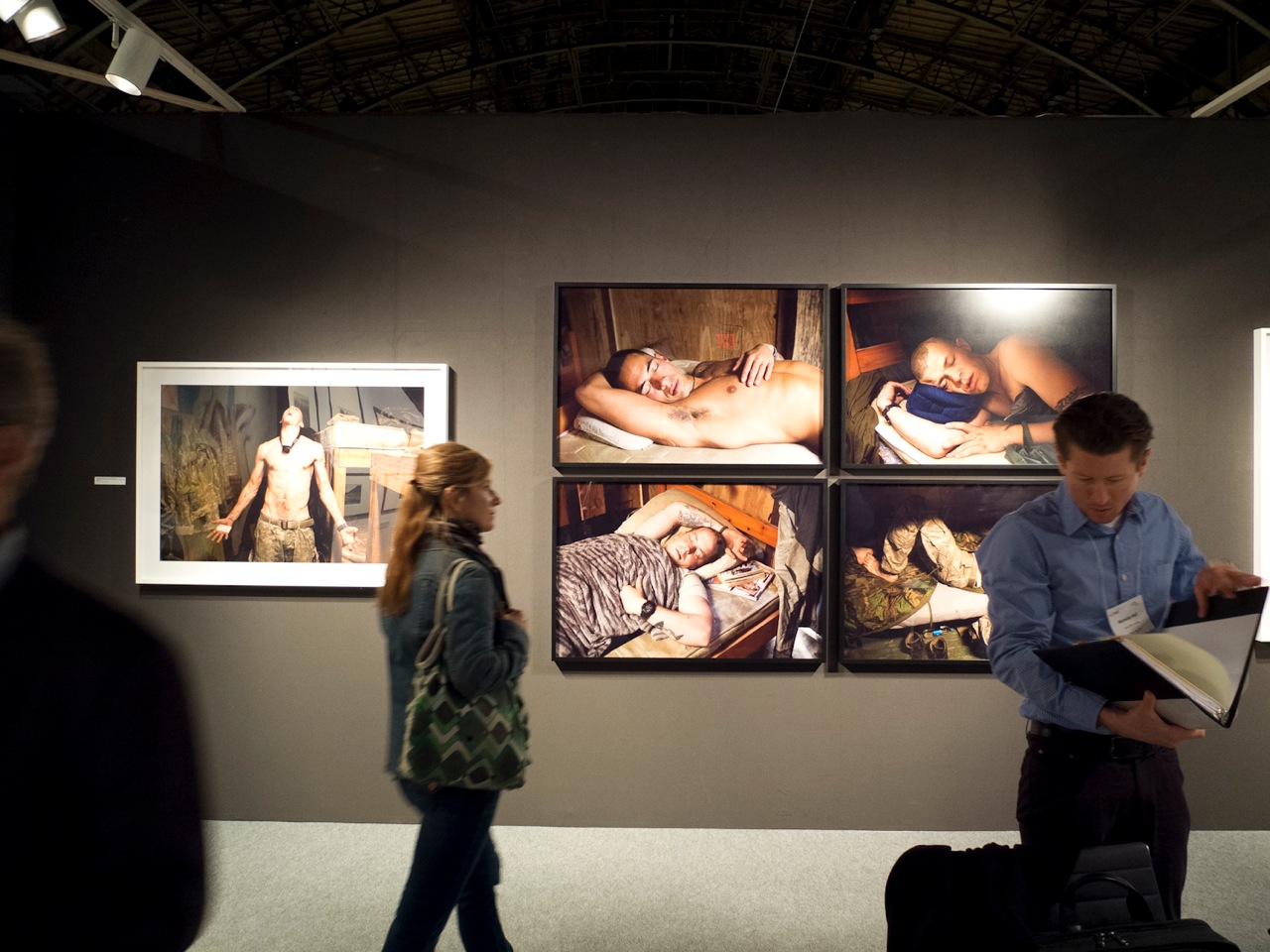
Walking into the back room where the Afghanistan photos are I am stopped by the shocking intimacy of the Restrepo work, especially the sleeping soldiers. As I look at the photo of the men fooling around I can still see Tim—imagine him there. That’s how strongly the experience is imprinted.

Tim Hetherington
Alcantara, Korengal Valley, Kunar Province, Afghanistan, 2008 Digital C-print (c) Tim Hetherington, Courtesy Yossi Milo Gallery, New York

Tim Hetherington
Kelso, Korengal Valley, Kunar Province, Afghanistan, 2008 Digital C-print (c) Tim Hetherington, Courtesy Yossi Milo Gallery, New York

Hung as though we are looking at men in childhood bunk beds, the impact of the work is heightened. I am once again struck by how young they all seem, and by how close they are to each other. There is a physical intimacy between the soldiers that you don't usually see in photos. But that is part of Tim's gift: his ability to become one with his subjects, and so they let him into their world. Tim held the door opened and allowed us to enter a world we are not a part of. That was one of Tim's gifts.

Like all artists, Tim Hetherington's work outlives him. For that I am grateful, but the loss is even more keen because of the unique way in which he viewed the world, and because of his fierce desire to peel back the obvious to show us the base from which the actions and emotions sprang.

I miss Tim Hetherington for who he was and for the promise of what was still to come.

Labels: , , , , , , , ,

del.icio.us Digg it Facebook MySpace Slashdot Technorati Stumbleupon Twitter

Tuesday, April 10, 2012

Between Despair and Determination Is…..?

It isn’t easy building and maintaining a creative career these days. The competition is fierce, the online noise deafening, and the energy it takes superhuman for many of us. When it all becomes too much to deal with, what do you do?

In navigating the choppy waters of livelihood, it’s important to grab whatever you can to work on. Taken piece by piece you can sometimes avoid the paralysis that comes with feeling overwhelmed. For me, that means sitting down and making a master list of what has to get done. I admit it, I LOVE lists. Or rather I love crossing things off lists. Gives me a great feeling of satisfaction.

Once I have the master list, I always see that there are different parts to it. It may be that there are immediate and long-range things, or it may be that there are business-related things and personal things. But once it’s down on paper (and yes, I still use paper and pen), the ball of confusion starts to break up, and I get the desire to do something.

The next thing I do is prioritize. I once read you should not have a list of more than three things to do each day, or you will get overwhelmed. I found that what works for me is making lists for each day of the week, so I don’t dread what I have to do, and each day I can move forward.

But sometimes an added problem is sitting in front of my computer for too long. It tires me out, muddles my thinking and doesn’t allow me to focus (there are FB posts! And email! And Twitter! And things to read! What to do, what to do?). If I could, I would attach an ejector button to my chair to force me out of the house. I find comfort in nature, and even in New York I am lucky to see trees outside my window. There are two little parks near me where the tulips are in bloom, the cherry blossoms full, and I try to just be in the moment.

When you work alone, it can make you crazy and longing for human interaction (I adore my cat, but she refuses to engage in conversation when I want it). That’s when it’s great that most people drink coffee, and I can make a date to meet with someone. Getting a different perspective on things is very helpful. Additionally, going to a gallery or museum, seeing a movie, even reading a book (the old fashioned way) can push me away from lethargy.

I’m writing this because this has been a problem for me recently. And maybe writing about it will shake me free.

Labels: , ,

del.icio.us Digg it Facebook MySpace Slashdot Technorati Stumbleupon Twitter

Monday, April 2, 2012

This is AIPAD 2012


Everyone’s been to AIPAD now, so time for the reviews to come in. I went twice, and felt overwhelmed at some point each time, but did come out with some thoughts I wanted to share.

There was a lot more contemporary work this year, and while I appreciated seeing such wonderful work (and it was mostly wonderful), when I think back, it can’t have the gravitas of the vintage work that I love seeing. I pretty much hated the contemporary work last year. This year there were a number of standouts.

Entering the exhibition, you stare directly at large format C-prints of Tim Hetherington’s “Sleeping Soldiers,” and 2 other prints of his soldier projects. To the right is an exceptional print of a man in a small Liberian boat, drifting past a rusted hunk of large ship. So amazing seeing it as a large print. Hetherington’s images all had an almost Rembrandt color palette that was very strong and emotional.
Yossi Milo represents his estate and will be opening a show on April 12. I’m really looking forward to it.

To the left when you enter is a wall full of Accra Shepp’s “Occupy Wall Street" portraits. There were 36 of them in a grid. And they were perfectly juxtaposed with Ernest Wither’s photo of the Memphis sanitation workers “I AM A Man” march in 1968. Steven Kasher made a very strong statement there.

Playing the “What would I buy if I had the money?” game, here are my choices:

Tim Hetherington—the Liberia image or one of the sleeping soldiers.
Ernest Withers
Anything by Bill Eppridge at the Monroe Gallery, maybe the anguished Medgar Evers family after his murder.
One of Katherine Wolkoff’s bird silhouettes "Found"(I loved everything at Sasha Wolf’s booth)

One of Michael Wolf’s voyeuristic Japan subway photos.

I also loved Emily Roysdon's “David Wojnarowicz Project" at Higher Learning. It was fresh, clever and well executed. The small B&W images really spoke to me.

I was pleasantly surprised to see work by so many photographers I knew, including Nina Berman, Laurie Lambrecht, Sandi Fifield, Martine Fougeron, and Justine Reyes. John Cyr’s developing tray project was there as well, and looked really good on the walls.

Now in the end I don’t know how successful this year’s AIPAD was for the galleries, but I saw many people, and enjoyed myself. It seemed fresher than last year, but I'm a real sucker for the vintage work, and that seemed to take a back seat. I'm on the fence about that. AIPAD is exhausting, and when it’s over, I find I need a break from photography.

If money was no object, what would YOU buy?

Photos by Jason Florio.

Labels: , , , , , , , , , , ,

del.icio.us Digg it Facebook MySpace Slashdot Technorati Stumbleupon Twitter

Monday, March 12, 2012

Cindy Sherman Doesn't Thrill Me

Cindy Sherman. Untitled #425. 2004. Chromogenic color print, 70 3/4″ x 7′ 5 3/4″ (179.7 x 228 cm). Courtesy the artist and Metro Pictures, New York © 2012 Cindy Sherman

Clowns? Really? You’ve got to be kidding.

I’ll say it right here, right now: I don’t like Cindy Sherman’s work.

Wait, let me say that more clearly: I don’t like MOST of Cindy Sherman’s work. And I definitely don’t see her as some kind of brilliant artist. Maybe she was once, when she was just starting out.

The Museum of Modern Art in New York just opened a retrospective of Cindy Sherman that will run until June 11. It’s a chance to see her beginning and development into one of the most successful photographers alive. Not only is her work eminently collectible, she is now holds the record as the photographer whose work has sold for the most money.

I walked through the exhibit twice in order to really get a feeling for the work and to clarify my feelings about it all. Here goes...

The show is hung chronologically, which allows you to see how revolutionary Sherman’s work was when it first showed in the mid to late 1970s. That was a time of all sorts of new art, including punk music. In that way she fits in perfectly with the energy of the times. Her explorations of identity (in black & white) really resonate and seem so fresh and smart even now.
Cindy Sherman. Untitled Film Still #6. 1977. Gelatin silver print, 9 7/16 x 6 1/2_ (24 x 16.5 cm). The Museum of Modern Art, New York. Acquired through the generosity of Jo Carole and Ronald S. Lauder in memory of Eugene M. Schwartz © 2012 Cindy Sherman

Identity is the subject of so much art, including every college students’ work. So even though I have seen it repeated over and over, there are few photographers I feel really nail something deep. Cindy Sherman’s work from 1975-1981, which includes her “Untitled Film Stills,” does exactly that: it throws all the stereotypical views of women in our society right back into our faces. And she was one of the only photographers doing it in those days.

From damsels in distress to secretaries to sexpots, it’s all there and I was honestly blown away. I didn’t think I would like anything I saw. I was wrong.

It was early in the 1980s when Sherman began her move to color film. And it was also when she began to create the personas we have all come to know. First she photographed herself in costume against projected landscapes. Then she was commissioned to “re-create” images from men’s “erotic” magazines. This is where she began to lose me. The images are nothing like what they are “supposed” to be, and I find them mundane. Yet as a former photo editor I can see the allure in having this new photographer explore the topic. For me it falls very flat, as if Sherman couldn’t really stretch herself to turn the idea on its head.
Cindy Sherman. Untitled #96. 1981. Chromogenic color print, 24 x 47 15/16″ (61 x 121.9 cm). The Museum of Modern Art, New York. Gift of Carl D. Lobell © 2012 Cindy Sherman

In the mid-1980s into the early 1990s Sherman turned her attentions and productions to fairy tales, the Masters, sex and deconstruction. Who cares? This is when she really began to alter her own appearance to create vaguely recognizable people in large format. I mean what can I say about a room full of large color portraits of people who might be seen in a Rembrandt painting? For me it is crass and looks really cheap.
Cindy Sherman. Untitled #213. 1989. Chromogenic color print, 41 1/2 x 33″ (105.4 x 83.8 cm). Courtesy the artist and Metro Pictures, New York © 2012 Cindy Sherman

I do find it interesting that the museum alludes to her work with sex toys, yet barely shows any of them.

It was also during this time that Sherman created a series of ‘fashion” photos, and as stated by the museum, “challenge(d) the industry’s conventions of beauty and grace.”

Sherman photographs herself as a burn victim, as what looks like a crazy woman all the time wearing very expensive designer clothing. But I ask you, isn’t there another level to turning conventions on their head than too skinny models at one end of the spectrum and Sherman’s overly ugly women? It seems to me as if she is taking each chance to do something new, and just shoe horning her work into it. Why is this so different than shooting a fashion spread in a slum area? Both characterizations hover on the surface without diving deeper into why it matters at all.

And how is a stereotype turned on its head by making herself, and consequently the women she looks to portray, as ugly as she can. I’m not talking about standardized beauty, but it seems she goes out of her way to make herself uglier and uglier for some purpose that eludes me.

So Sherman moves on into the 2000s and that is where the clowns first appear. Holy hell. Am I supposed to take this seriously? It makes me think of Jeff Koons and his porno sculptures with his then wife, Ilona Staller. Or Damien Hirst and his suspended dead cow. Is the point just to show that you can make people fall for anything and spend big bucks in the process? Wow, banality rules. What a surprise.

If it wasn’t bad enough that I felt I was seeing an artist becoming more and more irrelevant as her work progressed and she became more successful, I can’t understand why the photographs are so very large. The bigger they get, the more irrelevant they seem to me. It’s as if you print large just because you can (and of course you can charge more at that size), not because it’s warranted.

And so her most recent work, gigantic portraits of rich women not only do nothing for me, they hardly “presage(d) the financial collapse,” as the museum states. I just see more ugly women in photographs that are printed way too large. The colors are so saturated that they render them garish.
Cindy Sherman. Untitled #466. 2008. Chromogenic color print, 8′ 6″ x 70″ (259.1 x 177.8 cm). The Museum of Modern Art, New York. Acquired through the generosity of Robert B. Menschel in honor of Jerry I. Speyer. © 2012 Cindy Sherman
I couldn’t help thinking as I wandered through this exhibit about people who adore Madonna, thinking she somehow empowers women by changing her persona thus challenging stereotypes. That’s what this exhibit wants you to believe about Sherman as well. I don’t buy it. While Madonna always wants to be beautiful, Sherman strives for ugliness. Yet both performers (yes, I said performers) choose an easily identifiable way of portraying women.

I’m interested in women who look for the middle ground between what is offered to women by our male-dominated society, that being either being beautiful or being dismissed as ugly. I’m looking for women who turn convention on its head. Why can’t we set our own ideas of what women are, and why aren’t our artists leading the way?

Sherman reminds me of a band that releases one brilliant album with a dozen or so songs and then falls into endless mediocrity, doing basically the same thing over and over again because they can make a lot of money at it.

Stop!

You must be rich enough by now.

Labels: , , , ,

del.icio.us Digg it Facebook MySpace Slashdot Technorati Stumbleupon Twitter

Wednesday, December 14, 2011

PhotoNOLA 2011 Wrap Up

Now that I’ve settled back in at home I want to write about PhotoNOLA, one of the best photo festivals out there. It’s only a 3 hour flight from New York, so consider attending next year. You won’t be sorry.

I was there for the first time in 2008, and this year was so much better for me. I felt much more engaged, and by now, many of the other reviewers, and some of the photographers are friends, so I had a wonderfully social time.

I arrived Thursday for the fundraising gala, a party with fantastic food, music and great bargains on prints during the auction. It was my chance to hang out and meet new people while wishing I could own a lot of what was being sold.

On Friday I was able to go to the Insectarium, something I wasn’t able to do last time. I love insects, so it was a blast—I even got to eat some, which is something I wanted to do. The rest of the day was spent hanging out and eating, exactly what you expect to do in New Orleans.

Saturday and Sunday were all-day portfolio reviews. I saw some fascinating work and had a chance to meet other professionals I hadn’t met before. I know there is a lot of debate as to the value of portfolio reviews. I think they can be wonderful: a chance for photographers to get fresh eyes on their work, a chance to get face-to-face sit downs with high quality professionals, and a chance to meet and talk with other photographers. Yes, it will cost money. But aren’t you and your career worth it?

There are those who feel that reviews are a “pay for play” type situation, and you shouldn’t have to pay people to show them your work. I think it’s important to understand where that money goes. It goes to the organization that puts on the event (and putting together PhotoNOLA isn’t easy, and it isn’t cheap), and it goes to bringing the professionals to New Orleans. The reviewers are not paid, but their airfare and hotel are comped. I think that’s a pretty good deal all the way around.

Now if a photographer isn’t ready to be reviewed (their work is not far enough along), or they are not prepared with good work that is well presented, and don’t have both the ability to talk about their work and to hear what the reviewer says to then, then yes, maybe the reviews are not a good idea. But since most photographers work alone, in a sort of creative vacuum (especially if they are not in big cities), there is so much to be gained that I can’t support the review process enough.

Some of the work I saw that really stood out:

Patty Carroll’s study on domesticity:"Anonymous Women."

Christopher Chadbourne’s "State Fair"

Stephen Chalmers’s landscapes of serial killer murder sites

Alex Leme’s small town America project
Robert Llewellyn’s gorgeous "Seeing Flowers"
Calli McCaw’s boys jumping off the Coney Island pier

Sunday evening I was honored to be asked to moderate a panel called: “Picturing War,” which focused on the work of Sebastiano Tomada Piccolomini, Ashley Gilbertson and Jungeun Lee—three photographers showing alternate ways of depicting conflict. It was quite an emotional and engaging panel for all of us—panelists and audience. For my part, it was an unexpected and intensely emotional experience.

Ashley showed his work and featured the “Bedrooms of the Fallen,” a deep and moving portrait of the rooms of soldiers in the US and Europe who were killed in Iraq and Afghanistan. By projecting the work on a large screen you couldn’t help but feel as if you were in the rooms, and that made it all the more poignant. And Ashley’s fierce passion for his work and to the soldiers who struggle with returning to civilian life with PTSD, or who commit suicide brought us all to tears. You had to ask yourself: What am I doing to help these people?

Jungeun Lee’s "Silenced Suffering" about the Korean women who were kidnapped and forced to be sex slaves to the Japanese soldiers during WWII was extraordinary in its detail and execution. Jungeun had grown up in Korea never hearing about this—only when 200 of the estimated 200,000 women who suffered began to testify in public did she learn about it. Her anger was so intense, it took her a year to begin to figure out how to express it visually. Jungeun’s attention to detail, and talk about what she chose to focus on and how she came to it was incredible. I am in awe of her creative process and wish I could have seen the complete installation (I saw a portion of it on display in a gallery in town).

For the closing dinner we were invited to the studio of Josephine Sacabo, a gifted fine art photographer who specializes in the photogravure process. It was such a treat to see an artist studio while in town and it was the perfect end to the festival. I found myself sitting at a table across from Jessica Lange—not what I had expected.

So I have to thank everyone who put this wonderful festival together: especially the great Jennifer Shaw, whose book, "Hurricane Story" is one of my favorites. I had such a great time meeting and talking with, among others, David Bram, Brian Clamp, Jennifer Schwartz, Andy Adams, Bill Schwab, Holly Hughes, Bevin Bering Dubrowski, Kyohei Abe, Roy Flukinger, Charles Guice, Neil Harris, Maggie Kennedy, Alexandra Le Faou, Claire O’Neill, Gordon Watkinson, Ann Pallesen, Mary Virginia Swanson, Sasha Wolf and Gordon Stettinius. I wish I could have spent time with everyone.

So mark this on your calendar for next year, and I hope to see you there!

all photographs copyrighted by the individual photographers

Labels: , , , , , , , ,

del.icio.us Digg it Facebook MySpace Slashdot Technorati Stumbleupon Twitter

Thursday, December 1, 2011

"This Wild Idea"


Day 123: 9475 miles driven; 7930 photos taken; 30 cups of coffee; 25 places camped; 70 folks met.

That’s the most current tally for “This Wild Idea,” photographer Theron Humphrey’s one year road trip around America to find, photograph and record the stories of the people he meets.

“The idea is simple, the goal is straightforward, but I need your help! I’m going meet 1 new person a day, everyday, for 365 days. The goal is to makes images that age well and increase in value over time; images that will become part of your family story, which we can pass on to the next generation.”


It’s long been my belief that Americans feel no one listens to them (just check out the Occupy movement for more proof of that) and they want to feel connected to others. That is exactly what “This Wild Idea” is about. It’s a fantastic example of what you can do by just stepping right outside your door.

As Theron says,
“One day I woke up and realized how amazing it would be to hear my moms voice before she had me, or to hear my great-grandparents voices. To see them living their everyday. And I’ve always admired folks who’ve traveled the country and photographed the world, a lot have done it. And done it better than me. But something that was missing for me were folks’ names, I wanted to know that the photographers loved their subjects, that they shook peoples hands and told ‘em that they matter. So This Wild Idea is me getting out there and doing it, living my dream.”


And you can become a part of This Wild Idea is you like.
“The cool part of the project that it’s alive now,” says Theron. ”It’s free to access and look at and remember. Anyone across America can “Change my Route” and become part of the project. That’s pretty powerful. Instead of folks just being voyeurs to a photo project after the fact, we wanted to use social media to connect folks now.”


All photos Theron Humphrey

Labels: , , ,

del.icio.us Digg it Facebook MySpace Slashdot Technorati Stumbleupon Twitter

Monday, November 7, 2011

FAMBUL TOK, A Film About the Power of Forgiveness


I have been thinking a lot lately about forgiveness: of oneself, of those who have wronged us, and of all the little things we cannot let go of. Then yesterday I saw “Fambul Tok,Sara Terry’s documentary about reconciliation and forgiveness in Sierra Leone, and I was humbled.

If you don’t remember, Sierra Leone was at war from 1991-2002. Rebel groups trying to overthrow the government committed atrocities including hacking the limbs of people, kidnapping children and forcing them to kill, mass rape, and other things too horrible to mention here. You may remember that "blood diamonds" were used to fund the war. The world captured and is prosecuting Charles Taylor for his role, but the government of Sierra Leone gave blanket amnesty to all but a handful of men who led the carnage.

Fambul Tok,” or “family talk” involves bringing accuser and accused face to face before the community in order to heal. One admits their crime and asks forgiveness of the person wronged. If the person forgives, the community becomes whole again. For a war that broke communities apart, it is an incredible example of grace.

Sara Terry has been shining a light on what happens AFTER war for many years now with her work from Bosnia and her Aftermath Project. This is her first film. Along with cinematographer Henry Jacobson, they visited Sierra Leone at least a half dozen times in the company of John Caulker, the founder of "Fambul Tok," to let these African people tell their own story. It is at once overwhelming and beautiful.

None of us will ever experience anything even close to what the people of Sierra Leone have suffered. But the amazing ability of these incredible people to forgive brought me to tears over and over again. They have a strength I can only hope for.

I can’t let go of this film, and I can’t recommend it highly enough.

The final showing is tomorrow, Tuesday Nov. 8 at 11:30, at the IFC Center in the West Village. Don’t miss this documentary. It’s extraordinary.

You can purchase a DVD and a book of the story here. To find out more, go here I recommend you do both, and then invite your friends to watch with you. This is what grace looks like.

Labels: , , , , , , , ,

del.icio.us Digg it Facebook MySpace Slashdot Technorati Stumbleupon Twitter